
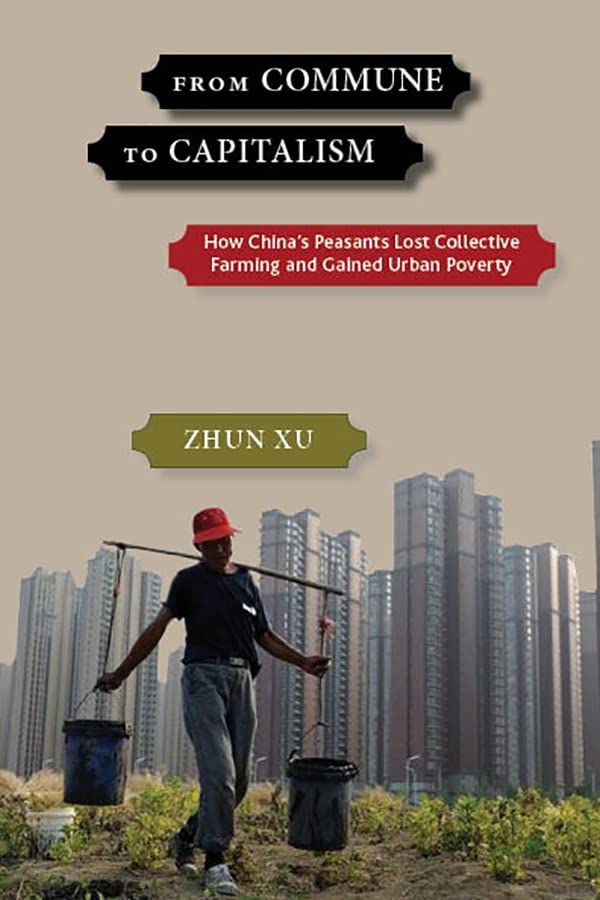
From Commune to Capitalism: How China’s Peasants Lost Collective Farming and Gained Urban Poverty
Produktdetails
| Artikelnummer | 231956503 | Erscheinungsdatum | 2026/06/18 | Listenpreis | €3.44 | Modellnummer | 231956503 | ||
|---|---|---|---|---|---|---|---|---|---|
| Kategorie | |||||||||
An account of China's transition into a global capitalist economy, as agrarian reform in the 1980s led Chinese peasants to industrial cities and into povertyIn the early 1980s, China undertook a massive reform that dismantled its socialist rural collectives and divided the land among millions of small peasant families. Known as the decollectivization campaign, it is one of the most significant reforms in China's transition to a market economy. From the beginning, the official Chinese accounts, and many academic writings, uncritically portray this campaign as a huge success, both for the peasants and the economy as a whole. This mainstream history argues that the rural communes, suffering from inefficiency, greatly improved agricultural productivity under the decollectivization reform. It also describes how the peasants, due to their dissatisfaction with the rural regime, spontaneously organized and collectively dismantled the collective system. A closer examination suggests a much different and more nuanced story. By combining historical archives, field work, and critical statistical examinations, From Commune to Capitalism argues that the decollectivization campaign was neither a bottom-up, spontaneous peasant movement, nor necessarily efficiency-improving. On the contrary, the reform was mainly a top-down, coercive campaign, and most of the efficiency gains came from simply increasing the usage of inputs, such as land and labor, rather than institutional changes. The book also asks an important question: Why did most of the peasants peacefully accept this reform? Zhun Xu answers that the problems of the communes contributed to the passiveness of the peasantry; that decollectivization, by depoliticizing the peasantry and freeing massive rural labor to compete with the urban workers, served as both the political and economic basis for consequent Chinese neoliberal reforms and a massive increase in all forms of economic, political, and social inequality. Decollectivization was, indeed, a huge success, although far from the sort suggested by mainstream accounts. Read more
| ASIN | B07C6BFKGR |
|---|---|
| XRay | Not Enabled |
| ISBN13 | 978-1583677001 |
| Language | English |
| File size | 1.5 MB |
| Page Flip | Enabled |
| Publisher | Monthly Review Press |
| Word Wise | Enabled |
| Print length | 143 pages |
| Accessibility | Learn more |
| Screen Reader | Supported |
| Publication date | June 22, 2018 |
| Enhanced typesetting | Enabled |
Korrektur der Produktinformationen
Wenn Sie Unvollständigkeiten oder Fehler in den Produktinformationen auf dieser Seite bemerken, nutzen Sie bitte das Korrekturformular unten.
Korrekturanfrage