
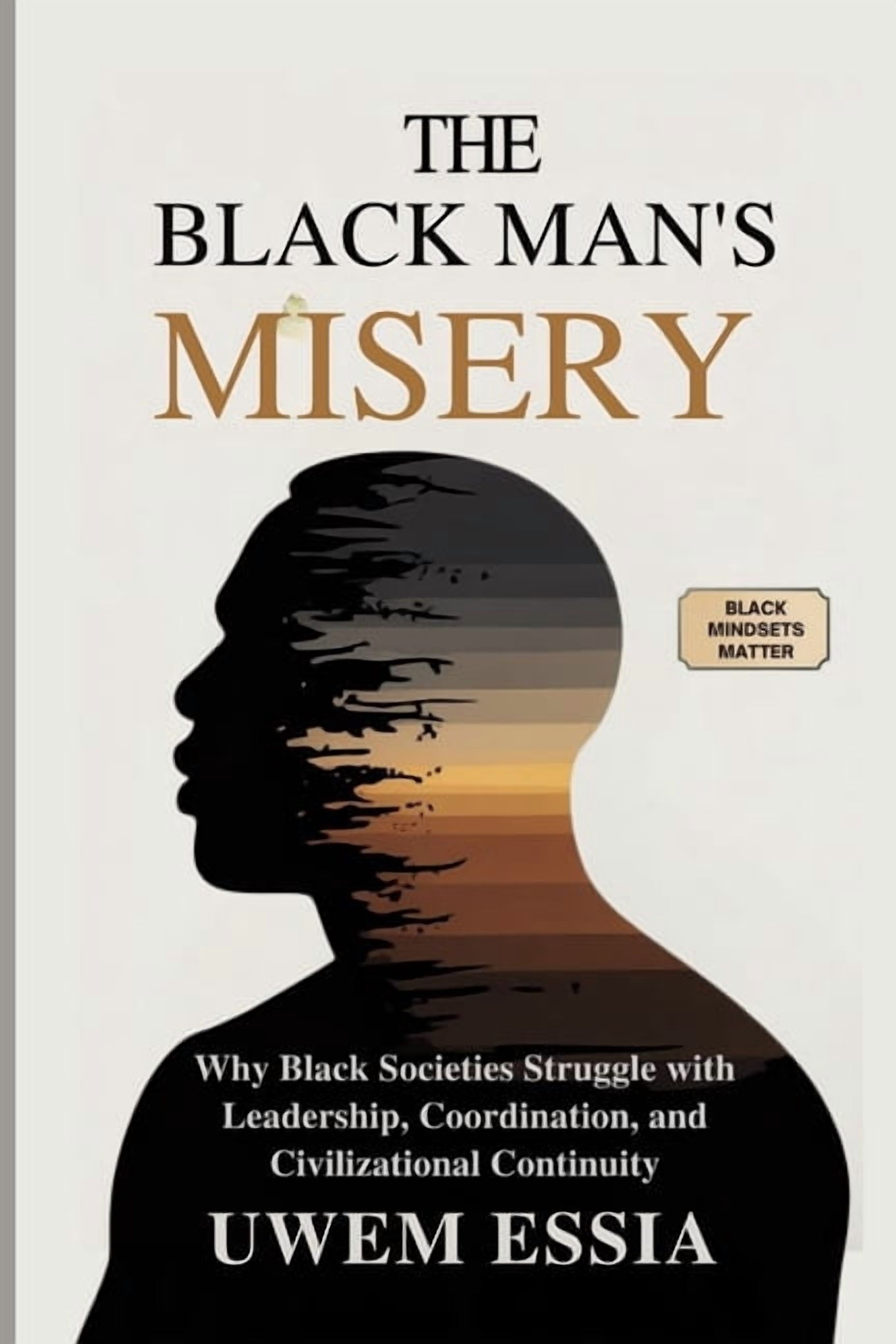
Pan Africanism The Black Man's Misery: Why Black Societies Struggle With Leadership, Coordination, and Civilizational Continuity: Black, Book 2, (Paperback)
Produktdetails
| Artikelnummer | 238740215 | Erscheinungsdatum | 2026/07/11 | Listenpreis | €8.00 | Modellnummer | 238740215 | ||
|---|---|---|---|---|---|---|---|---|---|
| Kategorie | |||||||||
Why do leadership failures, weak institutions, and stalled development keep repeating across many Black societies?<br>The <i>Black Man's Mi</i>sery is a policy-focused examination of a difficult question: why structural weaknesses in governance, coordination, and institutional continuity have persisted long after formal colonial rule ended.<br>This book does not deny history. Slavery, colonialism, racism, and extraction shaped starting conditions and caused deep disruption. But history alone does not explain why similar problems continue across generations, even as access to education, resources, and political independence has expanded.<br>The central argument of this book is simple: persistent underperformance is primarily an institutional problem, not a resource problem.<br>Misery, as used here, does not mean poverty or suffering. It refers to a civilizational condition in which leadership lacks accountability, institutions fail to coordinate, and progress resets rather than compounds. In such environments, effort exists, but it does not accumulate into durable capacity.<br>Drawing on political economy, development theory, comparative history, and governance outcomes, the book examines: <ol><li>Why leadership turnover without consequence does not improve outcomes</li><li>How weak accountability systems allow failure to repeat without correction</li><li>Why fragmentation across ministries, sectors, and regions blocks scale</li><li>How grievance narratives can preserve memory while discouraging reform</li><li>Why institutional continuity matters more than policy innovation</li><li>What functional Pan-African cooperation would require beyond symbolism</li><li>Why internal reform, not external rescue, determines long-term outcomes</li></ol>The book argues that development strategies fail when accountability is treated as an aspiration rather than a mechanism. Where rules are optional, incentives misaligned, and enforcement uneven, even well-designed policies produce limited results.<br>Rather than offering slogans or moral appeals, The Black Man's Misery focuses on structural realities. It shifts the discussion from identity and explanation to responsibility and design. The question is no longer who caused the damage, but what must be built to prevent its repetition.<br>This book is written for: <ol><li>Policymakers and civil servants</li><li>Development professionals and institutional reformers</li><li>Students of African political economy and governance</li><li>Readers seeking serious analysis beyond blame or rhetoric</li></ol>The argument may be uncomfortable, but it is grounded in historical evidence and institutional logic. Societies do not rise because they are morally right or historically wronged. They rise when accountability is enforced, coordination becomes mandatory, and institutions outlast individuals.<br>The Black Man's Misery is not a call for despair. It is a call for seriousness.<br>Its core message is clear: <br>Development begins when failure carries consequence. <p>Prof. Uwem Essia is a writer and development practitioner focused on leadership, institutional reform, and Africa's long-term development challenges. He has published on Pan-Africanism and worked with the Pan African Institute for Development (PAID), an early independence-era Pan-African institution headquartered in Yaoundé, Cameroon. His work combines historical insight</p>
- Pan Africanism The Black Man's Misery: Why Black Societies Struggle With Leadership, Coordination, and Civilizational Continuity: Black, Book 2, (Paperback)
- Author: Independently Published
- ISBN: 9798246305744
- Format: Paperback
- Publication Date: 2026-01-30
- Page Count: 350
| Book format | Paperback |
|---|---|
| Fiction/nonfiction | Non-Fiction |
| Genre | Political & Social Sciences |
| Publication date | January, 2026 |
| Pages | 350 |
| Subgenre | Comparative Politics |
| Series title | Pan Africanism |
| Number in series | 2 |
| Edition | 1 |
| Publisher | Amazon Digital Services LLC - Kdp |
| Original languages | English |
| Language | English |
| Is collectible | N |
| Recording time | 0 min |
| Retail packaging | Single Piece |
| Assembled product dimensions (l x w x h) | 6.00 x 0.73 x 9.00 in |
| Assembled product weight | 1.03 lb |
| Bisac subject heading | Political Science |
Korrektur der Produktinformationen
Wenn Sie Unvollständigkeiten oder Fehler in den Produktinformationen auf dieser Seite bemerken, nutzen Sie bitte das Korrekturformular unten.
Korrekturanfrage