
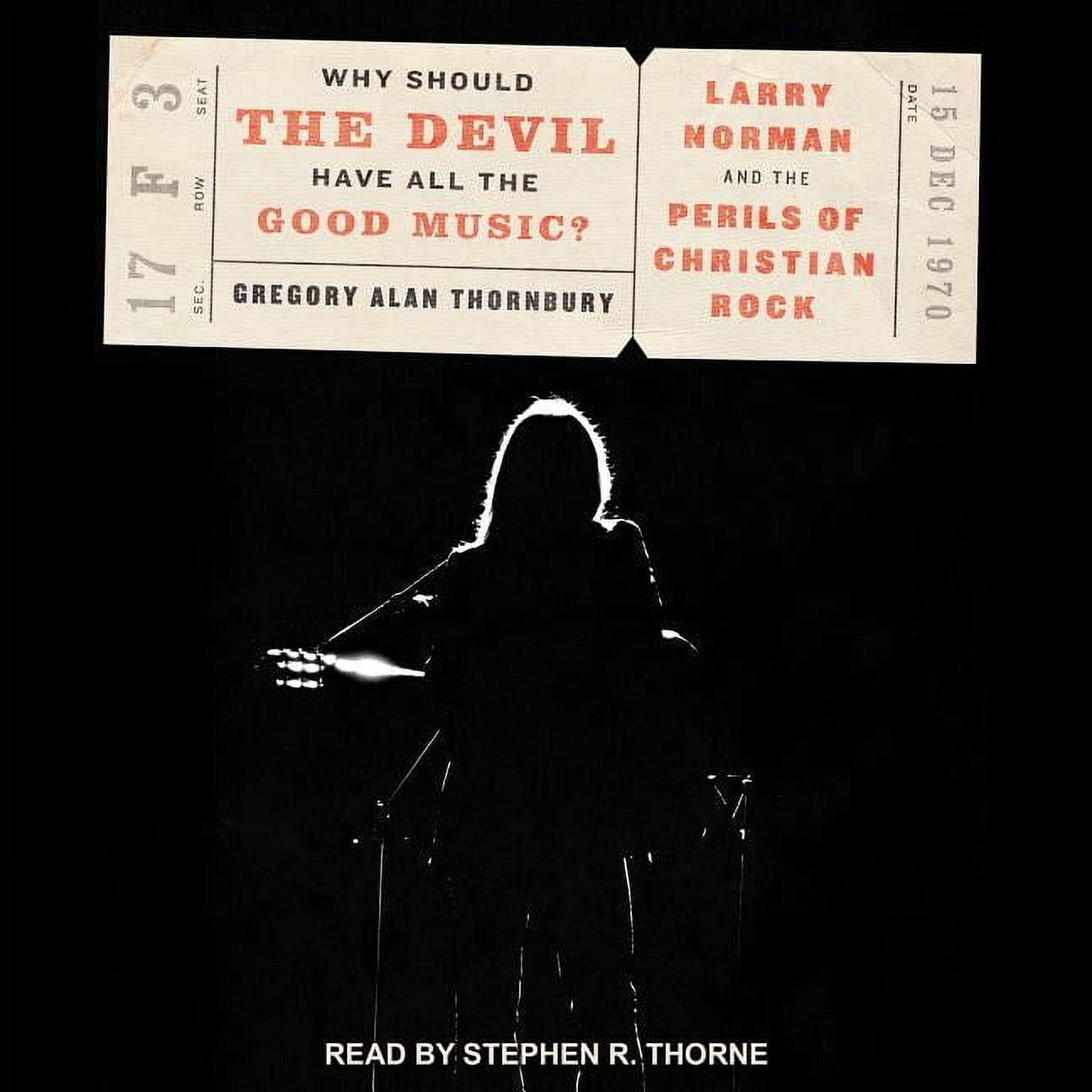
Why Should the Devil Have All the Good Music?: Larry Norman and the Perils of Christian Rock (Audiobook)
Produktdetails
| Artikelnummer | 240306710 | Erscheinungsdatum | 2026/07/16 | Listenpreis | €12.00 | Modellnummer | 240306710 | ||
|---|---|---|---|---|---|---|---|---|---|
| Kategorie | |||||||||
In 1969, in Capitol Records' Hollywood studio, a blonde-haired troubadour named Larry Norman laid track for an album that would launch a new genre of music and one of the strangest, most interesting careers in modern rock. Having spent the bulk of the 1960s playing on bills with acts like the Who, Janis Joplin, and the Doors, Norman decided that he wanted to sing about the most countercultural subject of all: Jesus. Billboard called Norman "the most important songwriter since Paul Simon," and his music would go on to inspire members of bands as diverse as U2, the Pixies, Guns 'N Roses, and more. To a young generation of Christians who wanted a way to be different in the American cultural scene, Larry was a godsend-spinning songs about one's eternal soul as deftly as he did ones critiquing consumerism, middle-class values, and the Vietnam War. To the religious establishment, however, he was a thorn in the side; and to secular music fans, he was an enigma. In Why Should the Devil Have all the Good Music?, Gregory Alan Thornbury draws on unparalleled access to Norman's personal papers and archives to narrate the conflicts that defined the singer's life, as he crisscrossed the developing fault lines between Evangelicals and mainstream American culture-friction that continues to this day.
In 1969, in Capitol Records' Hollywood studio, a blonde-haired troubadour named Larry Norman laid track for an album that would launch a new genre of music and one of the strangest, most interesting careers in modern rock. Having spent the bulk of the 1960s playing on bills with acts like the Who, Janis Joplin, and the Doors, Norman decided that he wanted to sing about the most countercultural subject of all: Jesus. Billboard called Norman "the most important songwriter since Paul Simon," and his music would go on to inspire members of bands as diverse as U2, the Pixies, Guns 'N Roses, and more. To a young generation of Christians who wanted a way to be different in the American cultural scene, Larry was a godsend-spinning songs about one's eternal soul as deftly as he did ones critiquing consumerism, middle-class values, and the Vietnam War. To the religious establishment, however, he was a thorn in the side; and to secular music fans, he was an enigma. In Why Should the Devil Have all the Good Music?, Gregory Alan Thornbury draws on unparalleled access to Norman's personal papers and archives to narrate the conflicts that defined the singer's life, as he crisscrossed the developing fault lines between Evangelicals and mainstream American culture-friction that continues to this day.| Book format | Audiobook |
|---|---|
| Fiction/nonfiction | Non-Fiction |
| Genre | History |
| Publication date | June, 2018 |
| Edition | Unabridged |
| Publisher | Tantor Media, Inc. |
| Original languages | English |
| Language | English |
| Edu focus | Music |
| Digital audio file format | All Digital Audio File Format |
| Narrator | Stephen R. Thorne |
| Assembled product height | 1.5 in |
| Assembled product weight | 1 lb |
| Bisac subject heading | Music, Religion, Biography & Autobiography |
Korrektur der Produktinformationen
Wenn Sie Unvollständigkeiten oder Fehler in den Produktinformationen auf dieser Seite bemerken, nutzen Sie bitte das Korrekturformular unten.
Korrekturanfrage